Showing posts with label Fashion File. Show all posts

Thursday, January 20, 2022

5 Steps to create a masterpiece Doll clothes designing with no drafting - Gingham fashion hack

Valspierssews doll clothes patterns


Are you looking for ways to save time and effort?

Do you wish you could design your own doll clothes but don't have hours and hours of drafting skills up your sleeve.

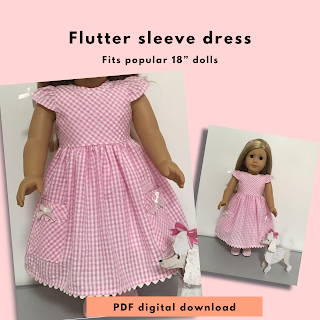
I'm always looking for more efficient ways to accomplish things. I made this pink dress from the pieces from 2 different patterns. No drafting required.

Step 1

One thing I love to do is scroll through all my Pinterest fashion images and select a design that I think will look good on the doll.

Step 2

Next I stare at the different pieces that make up the design and think about what patterns can I get those pieces from? Things like sleeves, collars, skirts, bodice shapes pockets and ruffles.


Step 3

Pull out the patterns and pick out the pieces I need. You can also bring up the files on your computer and print out the pages that you need.


Step 4

Work out what's missing and hope it is just some rectangles. Things like button bands or waist band features are just rectangles. Cut them a bit wider than you think you want because it is easy to try them out and trim them down.


Step 5

Make up your masterpiece using the instructions from the various patterns you cannibalised.

My latest masterpiece is this gingham dress with features that look great on the doll.

Step 1: I looked through Pinterest and found a little girls' dress that I liked.


Step 2: I analysed the features that made up the design.


Step 3: The features came from one 2 of my existing patterns. The 18" Dress and the 18" Gingham Midi Dress.

valspierssews doll clothes patterns


valspierssews doll clothes patterns

Step 4: The pieces I didn't have exactly were the waist band and the button band. Luckily these pieces are just rectangles cut to size.

  • I judged the width of the waist band by eye and measured out a rectangle 2 1/4" x 7".
  • I placed it on the bias and cut 1.
  • I folded it in half lengthwise and pressed it.
  • The waist band goes on the bodice after the collar sleeves and button band have been sewn into the bodice and before you sew the side seams.
  • Stitch it to the waist edge of the main bodice front.
  • Stitch it again close to the fold.


I've done a button band on other designs so I know what looks good.
  • It needs to end up 5/8" wide.
  • Cut the rectangle 2 1/2" x 6"
  • Place it on the bias and cut 1.
  • Fold it in half and press.
  • Open it out and fold each side to the centre.
  • Fold it again to make 4 layers with the raw edges enclosed.
  • Open out one end and turn up 1/4" and press.
  • Fold it back together again and press.
  • Stitch down the open side, across the bottom and up the other side.
Step 5
  • The button band is the first item to be basted to the neck of the main front bodice.
  • I then added the collar as per the instructions of the 18" dress pattern.
  • Then I added the sleeves as per the instructions of the Gingham Midi Dress. I transferred the sleeve placement dots to my 18" Dress bodice pattern pieces.
  • You may have some preferences for what edges you sew first. I sewed the armhole edges first then checked that the sleeves were rolled enough not to get in the way of the neck edge.
  • Use either the 18"Dress or the Gingham Midi dress instructions to do the lined bodice and side seams.
You can just see that I have understitched the collar and across the top of the button band.
That's why the button band is pinned down. I had to keep it straight.


I edge stitched the arm holes. So the stitching doesn't get in the way of sewing the side seams I start and finish about 1/4" from the side edge. Curve your line of stitching off the arm hole edge.


Leave the button band free of the bodice and out of the way while you sew the waist seam.


The skirt

I did the hem before the pockets.

Follow the pocket instructions for the Gingham Midi Dress.
  • I folded the flap just a little bit further to make the pocket a fractions shorter to fit on the shorter skirt.
  • I used the same placement measurements and placed the pockets 1 1/2" from the hem edge and 2" from the side edges.
  • Because my rick rack was very narrow I didn't enclose it in the seams. I stitched it on top and tucked the ends behind the flap. They got stitched in place when I sewed on the pocket.


Some of my past fashion Files have been made into full pattern files and put in the shop. I won't be doing that anymore. I am spending my time creating the pattern hacks and writing them up for the shop.

I hope your next action will be to look in Pinterest for some cute design ideas and see what you can use from the patterns you already own.

Make sure you are signed up to the newsletter for access to lots of patterns and tutorials. There is another cute pocket in the Newsletter Patterns and Tutorials folder that would go well with this dress.
It's no. 4 in the folder.

   Valspierssews doll designs


Happy Doll Dressmaking,
Val

Friday, February 8, 2019

Princess Line Doll Clothes: Part 1


18" doll clothes pattern by valspierssews. Variation on 1843 to fit American Girl Doll

  • Mixing up gores and panels and princess line
  • Fabulous vintage panels
  • Using 1843 to create these designs


Mixing up Gores, Gussets, Godettes and Princess line panels

I rediscovered the panelled dress that I made some time ago. I went looking for the pattern. It's title is 8 gore dress so I thought I would do a bit of research on what gores were because I had a feeling that I was not naming it correctly.

First I looked up the meaning of gore. It seems it is synonymous with gusset. The dress making version comes from a word meaning arrow.
The following comes from Wikipedia:
The word is derived from Old English gār, meaning spear. In the course of time the word came to be used for a piece of cloth used in making clothes. In dressmaking and hat making, it refers to triangular or rhomboid pieces of fabric which are combined to create a fuller three dimensional effect.

I also came upon this fabulous website called The Renaissance Tailor that I have book marked for some later reading. There looks to be lots of great information on historical outfits, drafting, sewing techniques and more. I have put the link to the site map because the menus seem a bit haphazard.
There was a great section on gores and gussets that helped clear up some misconceptions I had.

So a skirt can be made from trapezoidal gores. My 8 gore skirt pattern is correctly named. I also made a godette skirt pattern. It seems that gore and godette are the same but I tend to lean towards a godette being the triangular insert in a gored skirt.

So what is the princess line? 
Well, this is a relatively new fashion term thought to be introduce by Charles Frederick Wentworth in the 1870s. he named it after the elegant Princess Alexandra of Denmark.

A princess line is cut in long panels without any waist seam. the curve of the panels shapes the waist.

In 1951 Christian Dior presented a collection called the Line Longue that was based on the princess line.
I found a useful A to Z of sewing and fashion terms at the Business of fashion website

So I am going to rename my 8 gore dress to the 8 panel princess line dress.


Fabulous Vintage Panels

I looked up some examples of princess line dresses and some variations. The princess line is common in vintage designs.


You can find all these and more in my Pinterest board


Using 1843 to Create These Designs

My Princess line dress pattern is a great starting pint for recreating all these vintage designs. I love the pockets set between the panels.
I'm thinking I will have to include a round neck version in the pattern. At present it is a sweet heart neckline but if you cut straight across from the shoulder point then sew the panels together you can use any bodice pattern piece to shape the neckline.

This is pattern 1843...


... and this is a variation I made using the add-on bibs collection 1804a and the collar from 1804.


If you want to join the discussion on designing doll clothes then you need to join my Facebook Group


See Part 2 on how to vary the princess line design, and

Part 3 a tutorial detailing how to use 1843 to make a new design.

Happy Doll Dressmaking,
Val

Monday, July 16, 2018

FF30 Fashion File to make a cute baby doll dress from 1872 Easy T


I just love sewing knits. They are so easy to handle and they look fabulous.

Are you put off by the idea of sewing knit fabrics?

Do you wish you could make cute t-shirts but think it must be hard to do?

Sure, knits are different from wovens but they are not any harder to sew.
Get yourself a stretch or jersey needle...
(but to be honest I don't always use my jersey needle. Sewing with a narrow zig zag seems to prevent snags and pulling).

You don't need any seam neatening. It would take a lot of pulling to make most knits unravel.
Of course there are exceptions and it is pretty obvious when you handle them.


Did you have a go at the Easy-T straight dress I made first? You can find it here.


Instructions to draft you own baby doll T

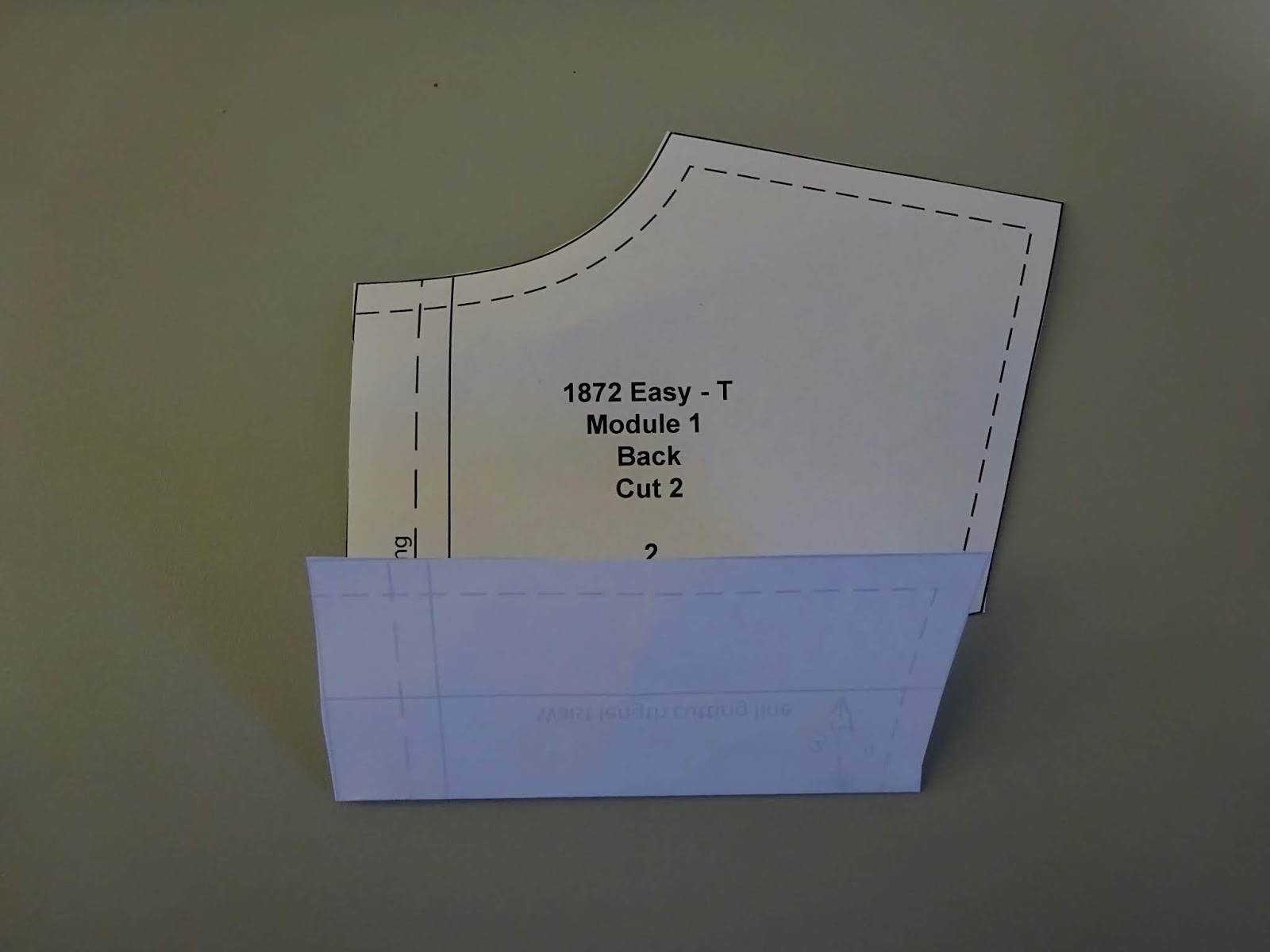
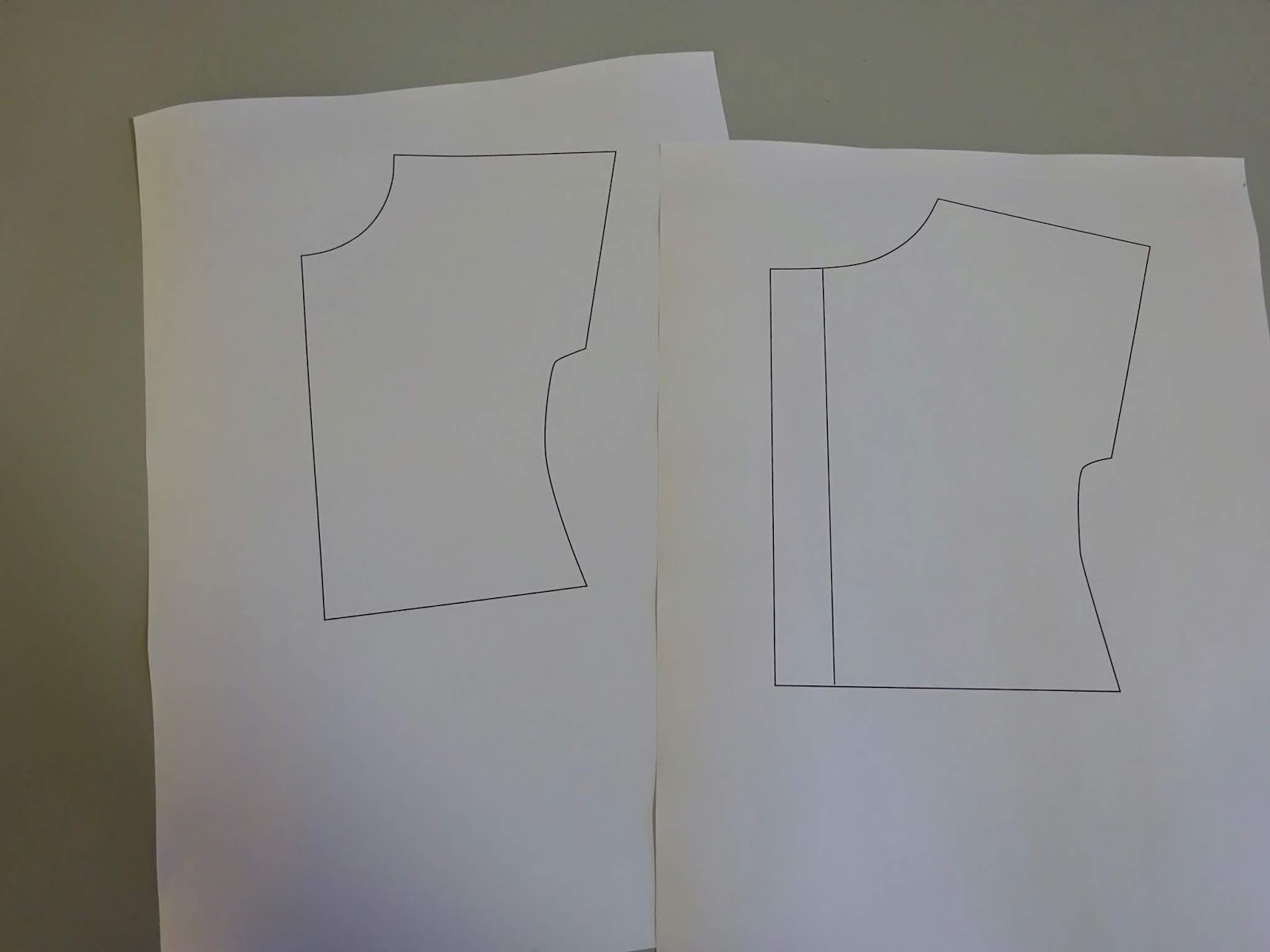
Print out new copies of the front and back of the Easy T Module 1 View 1

Measure 3/4" up from the waist length line and draw
a high waist line

If you have the version without the waist cutting line marked on
you just need to draw it in 1" above the bottom edge then do your
high waist line 3/4" above that.


You can do lots with the neckline but this time I am
just going to make it a fraction lower in the front by
drawing a smooth curve from the seam line at the CF
up to the neck edge on the pattern.

Trim off the neck and fold the bottom of the pattern
along the new high waist line. I fold it back then fold
it forward and leave it sticking up when I cut out.

Draw the new high waist line on the back

Fold on the line.

I planned for 8 3/4" finished length for the dress. 9" is normal short
but I wanted it a bit cute short but not as short as my straight t-shirt dress.
Subtracting the finished bodice length from the total I got 5" for the skirt
then added 1/4" waist seam allowance and 1/2" hem to get 5 3/4".
I cut two strips from my page 5 3/4" wide.
I then completed the skirt front by making a rectangle 5 3/4" x 6 1/4".
The 6 1/4" is half the front skirt plus one seam allowance.
Label the CF down the 5 3/4" side and name the piece.


I put the front on top of my second strip and made it 5 3/4" x 7".
The 7" allows for half the skirt back plus extra for the 1/2" facing plus
1/4" to create the 1/2" overlap on the finished back.

Draw in the facing fold line 1/2" from the side and label
the back facing and name the piece.
I added in the labels that the skirt was a high waist skirt
for the t-shirt dress so I would know it is a short skirt piece.

All the pieces together. Top back and front, Skirt back and front and
sleeve band and narrower neck band.

I usually fit the pieces on best I can. Here I am going to
cut the skirt out then refold the fabric and cut out the bodices.

Knit Stitching Tips

When doing neck bands I like to stitch the band together with
a narrow zig zag inside the seam allowance.
This holds the edges even when you stretch it.
You can see how narrow my zig zag is. It is barely 1 on my dial
and seems to look almost straight but it is enough to allow stretch and
stop the needle getting caught.

Don't stretch as you sew. It ends up curved.

Mark the centres of the neck band and bodice neck.

Pin at the centre and level with each end.

Hold one half and stretch it so the band fits the neck then
use a finger to hold things still while you put a pin it at your finger.
Do this on each half.

The bodice is looped between the pins.
Stretch the seam as you sew each section by holding it between your two hands
and letting it feed through. I use a narrow zig zag for seams and straight stitch for
top stitching, hems and facings.

I don't usually have a 1/2" hem. I would normally overlock it and turn up 1/4'.
This time I wanted it to look a bit flatter with no overlocking but also
be sure that it turned up cleanly with no running so I made it 1/2".

After stitching the waist seam I pressed it up and top stitched on the outside on
the bodice side of the seam securing the waist seam allowance with a straight stitch
You can see I haven't neatened the seams but they look neat.
The facing edges are just turned under and stitched down with a straight stitch the same as for the t-shirt.

Don't forget you can download an envelope to store the pieces you create
for your Custom Fashion Files.

Happy Sewing,
Val

Friday, July 13, 2018

How to Sew Doll Clothes: FF29 Make your own T-shirt Dress Using the T-shirt from 1872 Module 1

valspierssews

Nothing makes me happier than tinkering with my designs to create new designs. I do all the tricky drafting and all you have to do it find or imagine a design you like and use your available pattern pieces to put it together.

You will love how easy it is to create this cute design.

In this latest Fashion File I show you how to create a well fitting garment with little or no drafting skills.

Many of my individual patterns work like this but I also have several different ranges of patterns and if you choose patterns within the same range you will find that you can mix and match many of the design elements to make new creations without even drawing any new lines.

The Snugfit Range has the most patterns but there are some LooseFit Range designs for making coats or jackets.


Instructions to make the Easy-T Dress with a scoop neck line


You need knit fabric and ribbing.
I decided on the dark ribbing for my dress

Trace around the front and back of the Easy T in Module 1.
Put them near the top of the page. 
I wanted my dress to be fairly short so I chose 9" from
the middle of the shoulder to the hemline including
the seam allowance and 1/4' hem. 


Extend the CF cutting line down to the hemline.

The side edge fits out around the hips already so
you just have to extend it down to the hemline.
When you cut out the pattern piece make it curve a bit.

For the back you need to add the same amount to
the bottom. I measured what I added to the front. It was 2 7/8".
Extend the back edge to meet the hem edge and extend the side edge.

When I make a lower neckline I measure up from
the under arm. I didn't want it too low so I made it
3/4" from the cutting line. That is 1/2" from the
finished under arm. (I have found that you don't want to go
lower than level with the finished under arm.)


I thought the neckline should come away from
the neck at the shoulders for an easy comfortable look.
Just a 1/4" wider.
Now start the scoop by coming in straight from the CF
then scoop up smoothly to your new shoulder neck edge.


The back shoulder neck edge has to also be 1/4" wider.
The neck doesn't have to be lower so just blend it
into the CB.

Add a few labels like BACK and FRONT, EASY-T DRESS,
CF PLACE ON FOLD, BACK FACING etc.

I am using the sleeve band and the narrower neck band.

I had a 1/2meter. Each pattern piece needs about 10".

To store my efforts for another time I printed out my custom
envelope design and made it up. The doll outline  is there. You
just have to sketch your design on then outline the doll bits
that stick out. I also coloured mine in a bit.

The envelope template was for my Newsletter subscribers so if you would like the envelope you will have to go here and sign up for my newsletter after you click to download the file.

You can download the narrow neck band on the updated bands page from this blog post. No sign up required but it is only the bands.
If you need the pattern you can get it from my Etsy Shop here.


Happy Sewing,
Val

Valspierssews
Dressmaker to the Dolls